Categoria: Historical Cooking

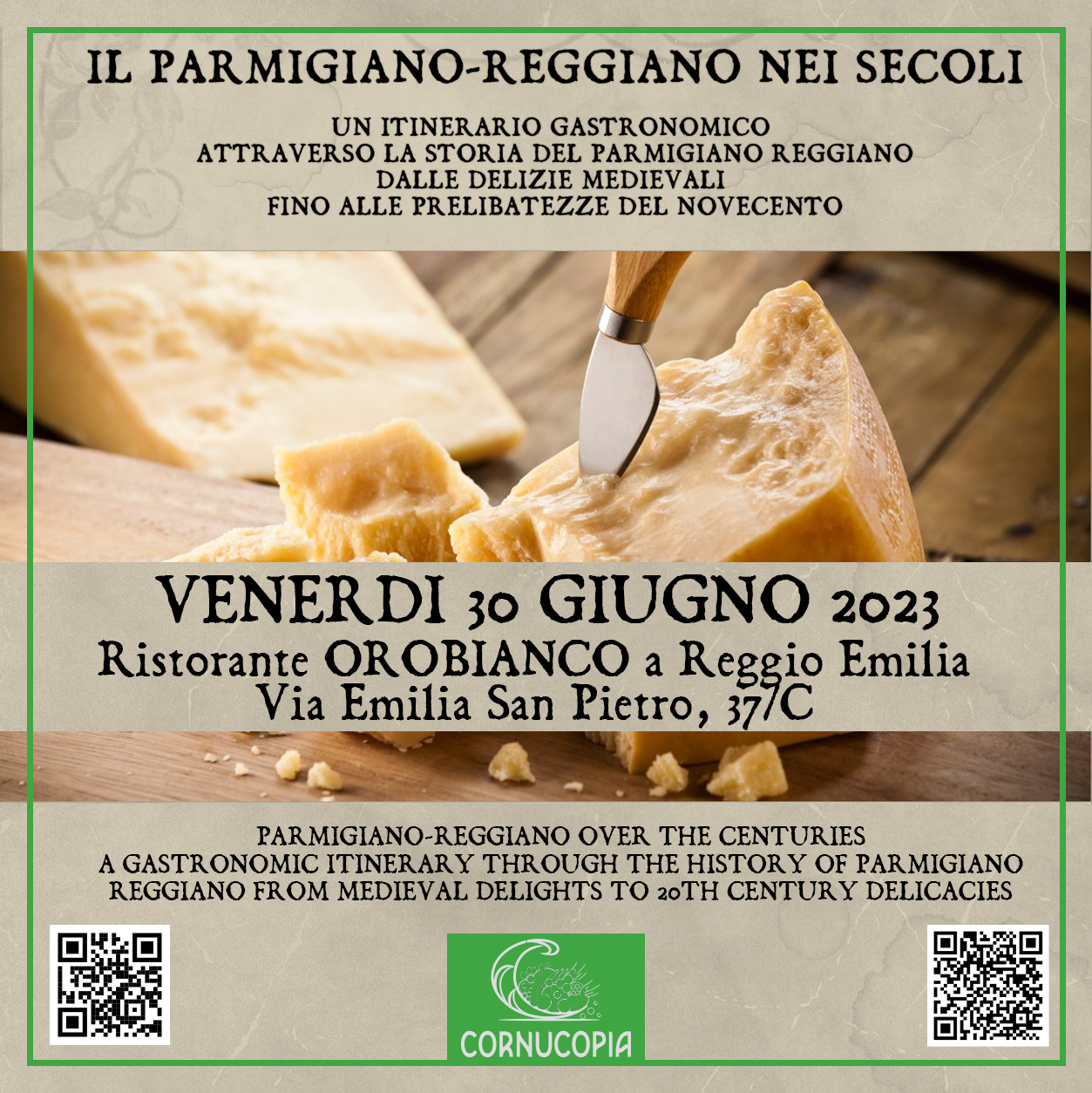
  • Un evento sulla storia del Parmigiano Reggiano

    Un evento sulla storia del Parmigiano Reggiano

    Nuova data 30 Giugno 2023!

    Finalmente ci siamo, sono ricominciati gli eventi Cornucopia per riscoprire le tradizioni enogastronomiche dell’Emilia-Romagna!

    L’Emilia-Romagna è una regione dell’Italia famosa per la sua cucina e i suoi piatti tradizionali. Tra questi, uno dei più noti e apprezzati in tutto il mondo è il Parmigiano Reggiano, un formaggio dalle origini antichissime che è diventato un simbolo della gastronomia italiana.

    Per riscoprire la storia e le tradizioni legate a questo formaggio, ho organizzato assieme l’associazione culturale Opalia una cena presso il nuovissimo ristorante Orobianco a Reggio Emilia.

    La cena, che si terrà il 30 di Giugno, sarà un’occasione unica per gustare piatti selezionati e preparati sulla base di ricette antiche, che rappresentano un vero e proprio viaggio nella storia della cucina emiliana dove si produce storicamente questo meraviglioso formaggio “a grana”.

    Nei prossimi giorni su questo blog pubblicherò una serie di articoli che ci accompagneranno per mano alla serata con una storia dettagliata della caseificazione fino alla creazione del consorzio e del disciplinare corrente.

    Sul blog è già stata pubblicata la storia della vacca Rossa Reggiana, la nostra autoctona di origini longobarde la cui vita è strettamente correlata a questo formaggio.

    Il menù della serata

    Il cuoco della storia Claudio Cavallotti presenterà tutte le portate della serata spiegando il contesto storico in cui sono state create. Attraverso una serie di piatti selezionati verrete trasportati dal tardo Medioevo fino agli ultimi secoli, in un percorso entusiasmante e ricco di sapori.

    Il percorso si articola attraverso i seguenti piatti:

    • antipasto, un particolare tortino del Novecento
    • primo, lasagne del Quattrocento, le famigerate “laganam cum caseo” di fra Salimbene
    • secondo, a base di Mora Romagnola e come contorno uno sformato di Parmigiano dell’Ottocento
    • dolce, un budino del Settecento, sempre a base di Parmigiano Reggiano

    Durante la serata sarà disponibile su richiesta un’alternativa senza carne (tuttavia, si ricorda per correttezza che il Parmigiano Reggiano viene prodotto utilizzando caglio animale). È importante che vengano segnalate in fase di prenotazione eventuali allergie alimentari!

    Come prenotare

    Le prenotazioni per la cena possono essere effettuate inviando una email a info@idea-cornucopia.it o un messaggio WhatsApp al numero 328 308 8091, oppure tramite le pagine Facebook del progetto Cornucopia o dell’Associazione Culturale Opalia.

    È necessario il raggiungimento di una quota minima di persone per l’evento, in caso di mancato raggiungimento verrà emesso immediatamente il rimborso.

    Per la serata è richiesto un contributo di € 40 a persona a favore dell’associazione Opalia, impegnata dal 2021 in opere divulgative sulla cultura gastronomica ed alimentare, importo che comprende anche acqua e due bicchieri di vino. Ulteriori bevande possono essere comunque consumate e pagate al locale dove è presente una gamma di vini genuini della campagna reggiana.

    🧀 Se volete, durante la prenotazione è possibile anche prenotare un kg di Parmigiano di Vacche Bianche Modenesi, allevate al pascolo secondo la tradizione dei secoli scorsi (la Vacca Bianca è un animale di pianura), con l’aggiunta di € 20 alla donazione (€ 60 totali).

    Se volete potete anche donare direttamente qui, mandando un’e-mail dopo la prenotazione: https://paypal.me/cornucopia20

    Dove e quando

    L’evento si terrà presso Orobianco, Via Emilia San Pietro, 37/C. Potete prenotare anche li se volete!

    Le coordinate GPS sono: 44°41’47.2″N 10°38’13.1″E (44.696444, 10.636966) (Google Maps non è molto preciso, ci troverete davanti la chiesa di San Pietro.

    Evento Eventbrite: https://www.eventbrite.it/e/661594054627

    Ci vediamo lì!

    La cena sulla storia del Parmigiano Reggiano è un’occasione unica per scoprire la storia e le tradizioni della cucina emiliana, attraverso piatti selezionati e preparati sulla base di ricette antiche. Non perdete l’opportunità di partecipare a questo evento unico nel suo genere e prenotate subito il vostro posto!

  • Italy’s ancient fruit preserves: the history of mostarda 🏺

    Italy’s ancient fruit preserves: the history of mostarda 🏺

    Pliny the Elder’s bones were tested by a youth spent in war among the Germanic peoples, his skin mottled with scars and signs of military life. He found relief when he walked thoughtfully and meditatively among the cultivated fields in the Roman countryside. Pliny stopped near a tree around which a vine filled with large sweet berries had grown. A vine grown in the Etruscan way. The sun was high on that autumn afternoon, Pliny picked a few grapes, held them up to the light, ate them, and noted the shape and characteristics of each berry. In the midst of the fields there were men gathering clusters in large containers. The scents of fruit and cooked must soon mingled together. This year Pliny turns 2000 years old, but the tradition of cooking grape juice to reduce it to syrup is much older.

    In Pliny’s time, the countryside was cultivated orderly close to the large urban centers. Despite the hard work in the fields and legions, these men followed a predominantly vegetable-based diet, even the richest patricians and emperors. Eating little and in a controlled manner was an important cultural tradition for them, but they were also able to enjoy a rich and complex cuisine where sweets were mostly made of fruit, a delightful symbol of prestige.

    The farmers of the ager cultivated the vine according to techniques learned from the Etruscans and Greeks. In addition to wine, which as one can imagine required complex processing for the time and various corrective interventions, grapes were also used as a sweetener, alongside honey, a tradition that has been passed down to this day, although not always in an obvious way (I will talk about this later). One of the most popular uses of grape must, to prolong its preservation, was in fact to cook it.

    Even today, cooked must is the basis, for example, of Traditional Balsamic Vinegar of Modena, in some remote farmhouses in Modena and Reggio Emilia, some enthusiasts still cook must in large cauldrons inherited from their grandparents. Even then, 2000 years ago, the must collected from these vines twisted around the trees (an article on the so called married vines will arrive shortly) was boiled, spreading the scent carried by the autumnal breezes in the air. This must was then used, among other things, to preserve fruit. During this period, cooked must coexisted with mostarda, the latter being an appreciated ingredient in spelt sausages and some vegetables, while the syrup obtained from reducing grape juice already had multiple purposes, such as a preservative for fruit.

    Under the banner of the Visconti’s blue dragon over a millennium later, in the medieval period, cooked must reappears once again used as a condiment and preservative, this time enriched by apothecaries with ground and boiled mustard seeds, another ingredient of ancient origin that made it an appetizing spicy condiment to use on meats (no, not yet paired with cheese, “It is ideal for marinated pork and tench” cites the Liber de Coquina, which also suggests enriching the must with cloves, ginger, cinnamon). It was a spicy must, in short, “mustum ardens”, present at that time in the kitchens of House Gonzaga in Mantua in northern Italy and then spread throughout the known world. Let us not forget the commercial power of these two ancient Lombard families.

    It is in this late medieval period that mostarda appears as we know it today. The term will re-emerge in French and English attributed only to the element that enriches the must, the “mustard” seeds. Up there this term would then become forever identified with mustard (which, in Italy is called senape), also worked as it was in that period, boiled (in vinegar) for days to remove the bitter tones. It is interesting to note a note dating back to the Venice of the 14th century, where the fat that dripped from the roasts was added to this sauce.

    De musto et mustarda: sic para mustum pro mustarda conficienda: accipe mustum nouum, fac eum bullire quod quarta pars solum remaneat uela. Et caue a fumo et spumetur bene. Deinde, semen senapi cum predicto musto distemperando tere fortissime. Postea, pone in barillo, et poterit conseruari per 4 menses. Et ualet pro carnibus porcinis uel tincis salsatis. Mustum poteris seruare pro aliis ferculis. Liber de Coquina, XIV sec.

    In the 15th century, Maestro Martino mentions a white mostarda made with almond paste, mustard, agresto (sour grape juice) or vinegar and breadcrumbs, and a red mustard that contained raisins. Interesting is the reference to a third dry mustard, “da cavalcata” (“suitable for riding”), to be kept in saddlebags during journeys and then revived when necessary.

    A few centuries pass and Christopher Columbus sets foot in the future Americas. The Middle Ages academically ends here and scattered mentions of mostarda appear, but it is still difficult to understand exactly what is meant by this term, apart from the name, there are no references to the processing.

    Persutti accedant primo, bagnentur aceto,Apponatur apri lumbus, cui salsa maridet,Tripparumque buseccarumque adsit mihi conca,Rognones vituli lessi sapor albus odoret,Insurgant speto quaiae, mustarda sequatur!Sic vivenda vita haec: veteres migrate fasoli!Teofilo Folengo, XVI sec.

    L’assenza vostra ci corrompe ogni piacere, et non sinit esse integrimi; però tornate ed arete mustarda, e ogni bene che con voi ne portaste.Francesco Berni, XVI sec.

    We finally arrive in Carpi in the Renaissance period where grape must and mostarda are finally united in marriage (the famous “mostarda fina” on which I absolutely want to write an article in the future, but the documentation is scattered and difficult to find). Mustard begins to detach from the saba and will still appear with more or less shaded differences with the term “savor” (from saba, precisely, the cooked must) in the Bolognese and throughout Italy south of Lombardy, think of Sicilian mostarda, thickened with flour. Remaining in Emilia-Romagna, at the end of the 19th century Artusi mentions it as an excellent product of Savignano on Rubicone, for example, but the popularity of this condiment will remain linked to Lombardy and the territories of House Visconti and House Gonzaga influence as candied fruit immersed in a sugar and mustard syrup. It becomes, in effect, a “conserva”.

    It is worth making a quick note at this point about the city of Modena and its “mele campanine” (Campanine apples). The characteristic Campanino becomes the most distinctive element of Mantuan mostarda. Let us not be surprised, Modena had a brief period of Mantuan domination and anyway the relations between House Este (let us think of Isabella d’Este) and Gonzaga have always been very close. At an enogastronomic level, Modena is closer to Mantua than it is to Rimini or Cesena.

    We have as we have already said arrived at the 1800s, the century of Pellegrino Artusi. In an early 20th century text, the mustard of Cento is mentioned… I have found nothing about it, but if anyone has any information, please write me an email or share the research on the Facebook group of historical gastronomy enthusiasts or on the Telegram group.

    In this period, the documentation is richer and more generous. The mustard contained in the “mostarda”, it is said, was used to cover some defects of meats and preparations, it is not difficult to think that this has always been one of its main uses.

    Essentially, there are three different types of varying quality, also derived from the increasingly abundant presence of sugar that replaces the cooked grape must and honey: those based on reduced wine or cooked must are the cheapest and can be clarified with egg white (we remember the controversy over “vegan” wines), in the middle range are those based on honey (“mele” in old italian), and finally the best, based on sugar. With the spread of sugar beet in the Napoleonic period, these too will become a popular product, detached from court gastronomy. The historian Marc Bloch, as we all know today, wrote a seminal text on the production of jams (and yes, the differentiation of citrus-based marmalade is recent history).

    Two centuries ago, the production of these motarde, apart from the sugary base, was nevertheless similar. There are fascinating descriptions of early 20th-century procedures that describe fruits dried in the sun instead of candied. The mostarda was cooked on the edges of large cast-iron stoves where it had to simmer gently and be frequently stirred and skimmed so that the juice would not stick to the bottom. Interesting are the packaging techniques of our fathers, who filled the jars starting from the fruit that remained on the surface and therefore less cooked, adding that from the bottom on top, techniques of peasant wisdom that are still repeated today in large kitchens.

    The Cornucopia Experience

    Few traditional food products recall the flavors of the Middle Ages like mustards, with their sweet-spicy contrast to be paired with fatty and savory dishes. That of Campanine apple mostarda is probably the most emblematic representation of this sauce (or preserve), which combines a specific variety with a traditional processing.

    A small quantity of organic mostarda, which I have selected for authenticity and research of the product from the field to the laboratory, will soon be available for purchase in the e-commerce section. Products with this adherence to Cornucopia principles have been chosen to experience firsthand the history of our food and wine heritage, the same taste experiences as our ancestors.

    Follow the website, page, or channel for updates on a Cornucopia product that I am developing precisely these days, a product that combines the history of mostarda with that of the Campanina variety.

  • The historical Macaroni Bolognese

    The historical Macaroni Bolognese

    For Bianchino and Sibillone

    Pellegrino Artusi

    Pellegrino Artusi was a wealthy man, born in what would become Romagna in pre-unification Italy in the early 1800s. A man who basically had two lives, split by a violent event that happened on his way out of a theater, not unlike what happened to Batman and his parents, a kind of dark knight of gastronomy in short, with a more disillusioned, sometimes cynical second life, but with a deep sense of ethics and morality.

    Artusi was born into a wealthy environment, lacking a thorough education and devoted to the pleasures his station allowed him until he was 30, in the then Church state, at the time when the turmoil of the struggles that followed the chaos of 1848 led to the first of Italy’s three Wars of Independence. In the twilight of the first of these, just before Cavour became prime minister, a young Artusi was walking home after seeing a poem inspired by another battle, a biblical narrative that led to the death of the Canaanite general Sisarah at the hands of a prophetess of Israel. The spiral of violence that the 30-year-old Artusi saw on stage, however, unfortunately, did not end in the theater, as his home was ravaged by brigands, and his sisters were met with a frightening fate.

    Pellegrino’s character and life took a profound turn that day. He moved to Florence and very soon retired to a life of study in the then Grand Duchy of Tuscany. The other Wars raged and strong cultural currents brought unthinkable revolutions even in academia (his path often intersected with the chair of Agriculture in Florence). He devoted himself to the arts, literature, as well as gastronomy, with a disillusioned and fiercely anticlerical slant. He never hid his aversion to religion, preferring a more secular and universal view of the great principles of progress and coexistence among peoples. One of these was the conscious fusion of cultures, which saw in food a direct expression of their identities. The vicissitudes he faced in publishing his celebrated collection of recipes and scientific reflections on regional Italian cuisine at the dawn of its founding are many and deserve a separate article, but it is interesting to see how the evolution of the manuscript from less than 500 recipes (475) mostly from Northern Italy ended with a version of almost 800, several editions later, all edited by him. Today we will tell about one of them, which Pellegrino brings back from his experience in Bologna not too far from his birthplace, Macaroni Bolognese (Maccheroni alla Bolognese).

    A half glass of cream makes it more delicate, says the Pelly

    Pellegrino describes his recipes by inserting reflections of a more or less scientific nature. In this case he is not particularly kind to the pasta he met in his Tuscany, where he resided, by the way, until his death. In describing his macaroni, he describes soft wheat pasta as tending to flake. At that time, Strampelli had not yet developed his new varieties; it is presumable that Pellegrino was referring to something like the wheat of plenty, which had been known for centuries (perhaps even since the time of the Roman Empire) and identified by Linnaeus in the late 1700s.

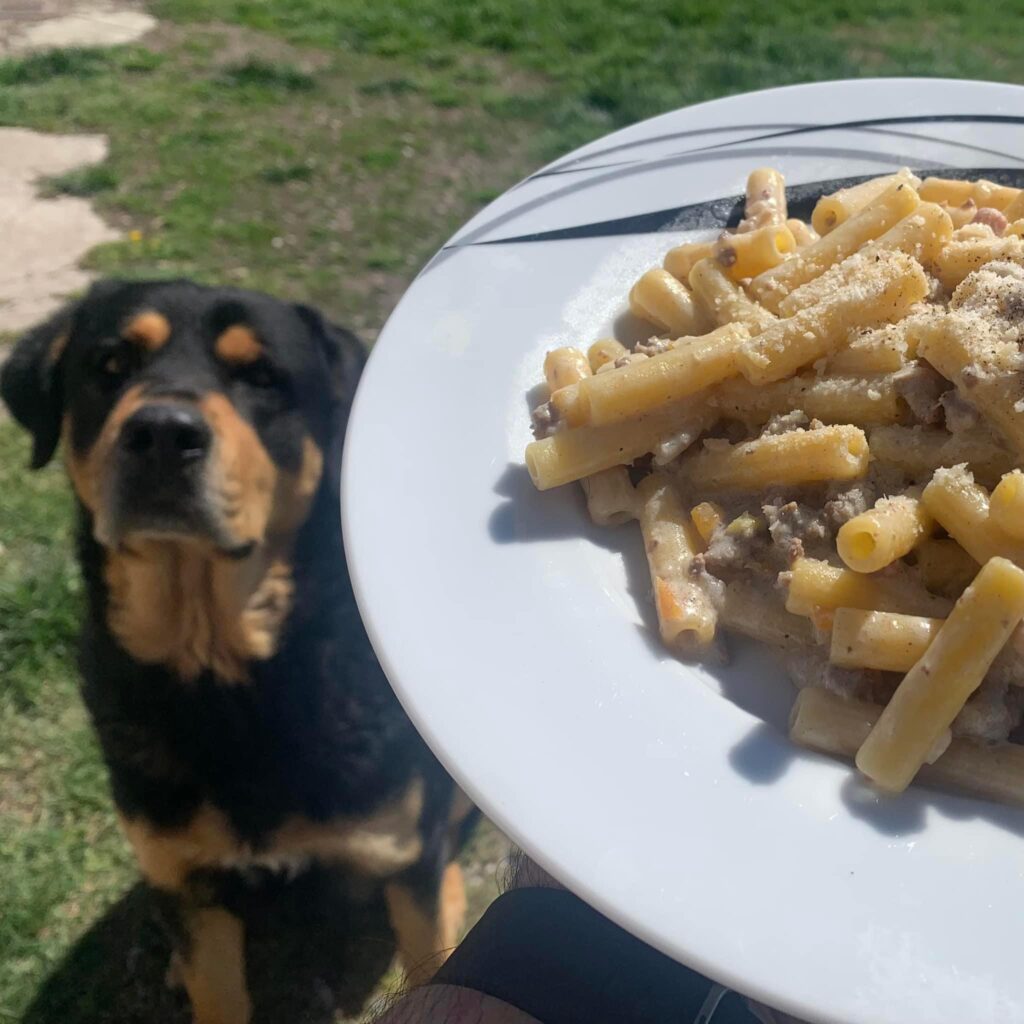
    The first striking thing about his macaroni is that it is “in bianco.” Tomatoes had not yet totally entered pasta recipes as we use them today, so it is not surprising that the use of a mixture of lean beef and pork fat, combined with the flour/butter/cream combination is more reminiscent of a lasagna filling than a ragout of today, even if Bolognese.

    Even the suggested addition of cream, chicken innards, or truffles is reminiscent of the flavors of a sophisticated baked pasta.

    Going to the ingredients I will try to suggest some varieties of Emilia-Romagna’s biodiversity, in conjunction with the Cornucopia idea.

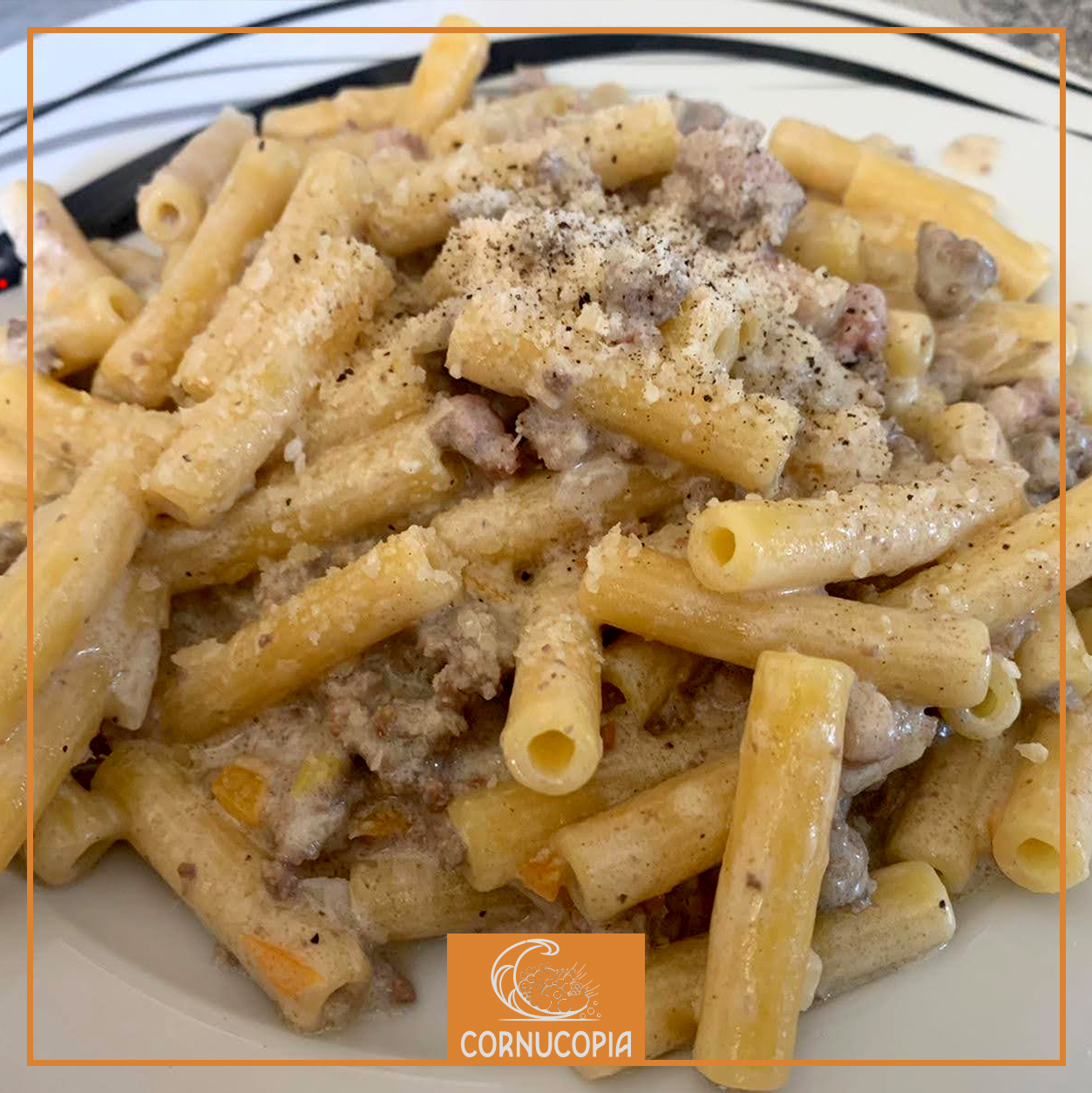
    Maccheroni alla Bolognese

    • Lean veal (preferably in the tenderloin), Romagnola breed gr. 150.
    • Carnesecca (“pancetta tesa e salata”, Mora Romagnola breed), grams 50
    • Butter (Bianca Val Padana or Rossa Reggiana), grams 40
    • A quarter of a common onion.
    • One half carrot.
    • Two palm-long ribs of white celery, or the smell of green celery.
    • A pinch of flour, but very little (some variety from the Apennines, Mentana for example).
    • A small pot of broth.
    • Very little salt or point, on account of the carnesecca and broth being flavorful.
    • Pepper and, for those who like it, the smell of nutmeg.

    Cut the meat into small dice, finely chop with the lunette the carnesecca, onion and herbs, then put everything on the fire together, including the butter, and when the meat has taken on color add the pinch of flour, basting with the broth until cooked through.

    Drain the macaroni well from the water and season it with Parmesan cheese and this gravy, which can also be made more grateful either with bits of dried mushrooms or with a few slices of truffles, or with a liver cooked between the meat and cut into small pieces; add, finally, when the gravy is made, if you want to make them even more delicate, half a glass of cream; in any case, it is good that the macaroni come to the table not secco arrabbiato, but diguazzanti in a little sauce.

    Pellegrino Artusi, “Science in the kitchen and the art of fine dining”
    Pantagruel seems to appreciate
  • The Forked Grapes

    The Forked Grapes

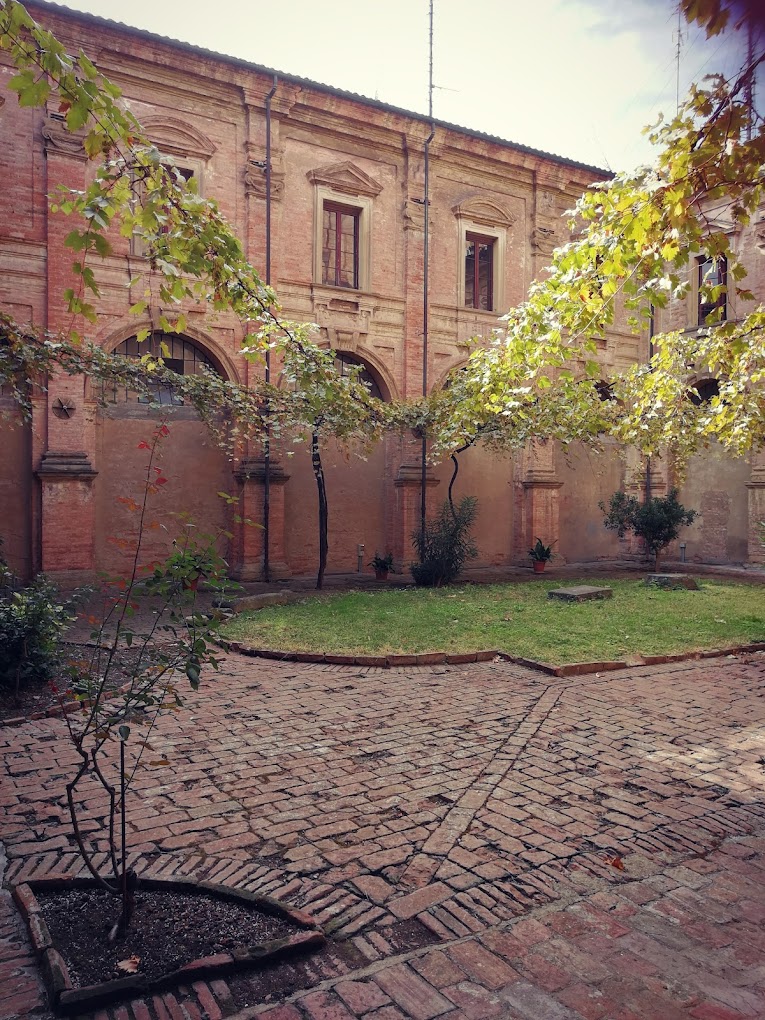
    It was the early 1600s when Marquis Vincenzo Tanara in Bologna wrote the splendid L’economia del cittadino in villa (The citizen’s economy in the villa), which we have also mentioned in other articles. Tanara, a magistrate and marquis in the then papal state, leaves us writings rich in detail concerning the administration of a mansion in a Bologna of bygone days, just a few decades after the famous coronation of Charles V at San Petronio. “On my kingdom,” goes the Emperor’s famous phrase, “the sun never sets” (In meinem Reich geht die Sonne niemals unter). And it is good that this is so because a good vineyard requires sun, wind, water and land. It was also during those years that the cloister of a Benedictine monastery was built, which is of interest to us because it houses a very old vine that is still, all things considered, going strong, in the very center of Imola.

    Tanara is famous in agrarian and gastronomic historiography for many reasons, but of particular interest to us today is his classification of vines at that time, among which ticks the name of a grape that has held its own in the area for centuries, the vine of that cloister. The Forcella grape (the Fork).

    Around the Forcella orbits a confusion that spreads even on today’s ministerial documents, where it is only derubricated as a variant (or “clone”) of Albana di Romagna, so called because of the bifurcation that its long clusters present at their end. Today, however, we are not dealing with Albana Forcella, but with the Forcella that was also cultivated for centuries in the town where I live, Castelfranco Emilia. Or rather, it was even cultivated in the street where I live, although it has obviously been extirpated entirely. Fortunately, a far-sighted person has recovered cuttings so the Forcella of the street where Ser Parsifal lives are still alive, and will give us excellent wines.

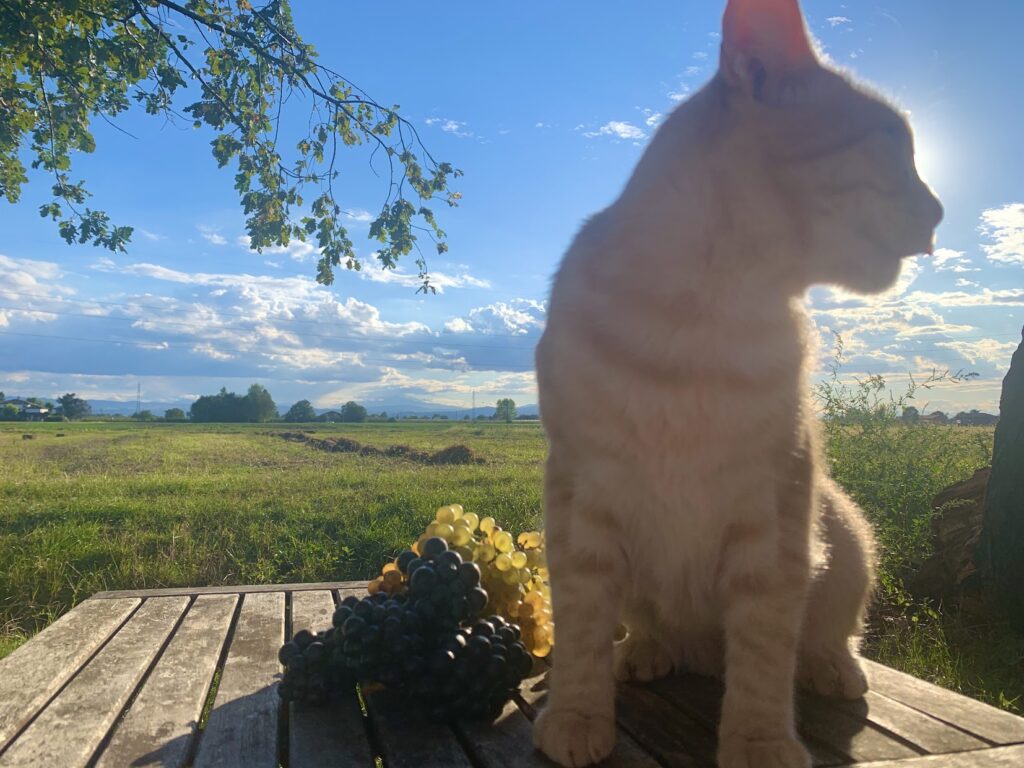
    Ser Parsifal oversees his estate- on the horizon the land where he grew among other grapes, the Forcella

    This vine is becoming less and less widespread, a fate that in this area has also befallen the other great absentee of local wine biodiversity: the Alionza. The only one that still enjoys some health is the equally historic Montuni (with which an honest Bianco di Castelfranco Emilia is produced).

    An important 1914 text edited by Cavazza mentions Forcella as being used for the production of table wines, given to the sapling, rustic and expansive, very productive and almost always used in blends. It is a passage that leads to many reflections on the nature of an area everywhere less and less interested in its historic winemaking vocation. Around the home of my lord Ser Parsifal above, the lands now host blanket cultivations of Lambrusco and Pignoletto of not only often terrifying quality but stubbornly condemned to single-varietal, when I wonder if this could still be a land of great whites, in the hands of skilled winemakers.

    Vite  secolare nei pressi di Santa Maria in Regola
    Patriarch of the fruit in the former Benedictine convent of the Olivetan congregation, Imola

    To honor the city of Imola and the Forcella plant above, today’s Cornucopia recipe will be about a typical local dessert, handed down to us thanks to a recipe by the very famous Pellegrino Artusi.

    Migliaccio di Romagna con saba di Uva Forcella

    • Milk, deciliters No. 7.
    • “Undone” pig’s blood, grams 330.
    • Forcella grape sapa, grams 200.
    • Peeled sweet almonds, grams 100.
    • Sugar, grams 100.
    • Very fine breadcrumbs, grams 80.
    • Candied fruit, grams 50.
    • Butter, grams 50.
    • Fine spices, two teaspoons.
    • Chocolate, grams 100.
    • Nutmeg, one teaspoon.
    • One strip of lemon peel.

    Pound in a mortar the almonds together with the candied fruit, which you will have first cut into small pieces, sprinkle them from time to time with a few teaspoons of milk and pass them through a sieve. Place the milk on the fire with the lemon peel, which must then be removed, and boil it for 10 minutes ; then add to it the grated chocolate, and when this has melted, remove it from the fire and let it cool a little. Then pour into the same pot the blood, already passed through istaccio (sieve), and all the other ingredients, saving for last the breadcrumbs, of which, if it were too much, a part can be left behind. Put the mixture to cook in a bain-marie and remove it often with the ladle so that it does not stick to the pot. The cooking and the degree of right density that is needed can be known from the ladle, which, left in the middle of the mixture, must remain upright. If this does not happen, add the rest of the breadcrumbs, assuming you have not poured it all in. For the remainder, do the same as for the ricotta cake No. 488, that is, pour it into a pan lined with the flat dough No. 118 and, when it is well browned, cut it into almonds. Cook the pasta matta a little so that it can be cut easily, and do not let the migliaccio dry out over the fire, but take it out when it comes out clean a granata twig dipped in it. If you use honey instead of sapa, taste it before adding the sugar so that it does not turn out too sweet, and note that one of the virtues of this dish is that it is mantecato, that is, of very fine composition. The fear of not being understood by everyone, in describing these dishes, often makes me descend to too much minute detail, which I would gladly spare.

    Pellegrino Artusi, La scienza in cucina e l’arte di mangiar bene
  • Grandma’s apple

    Grandma’s apple

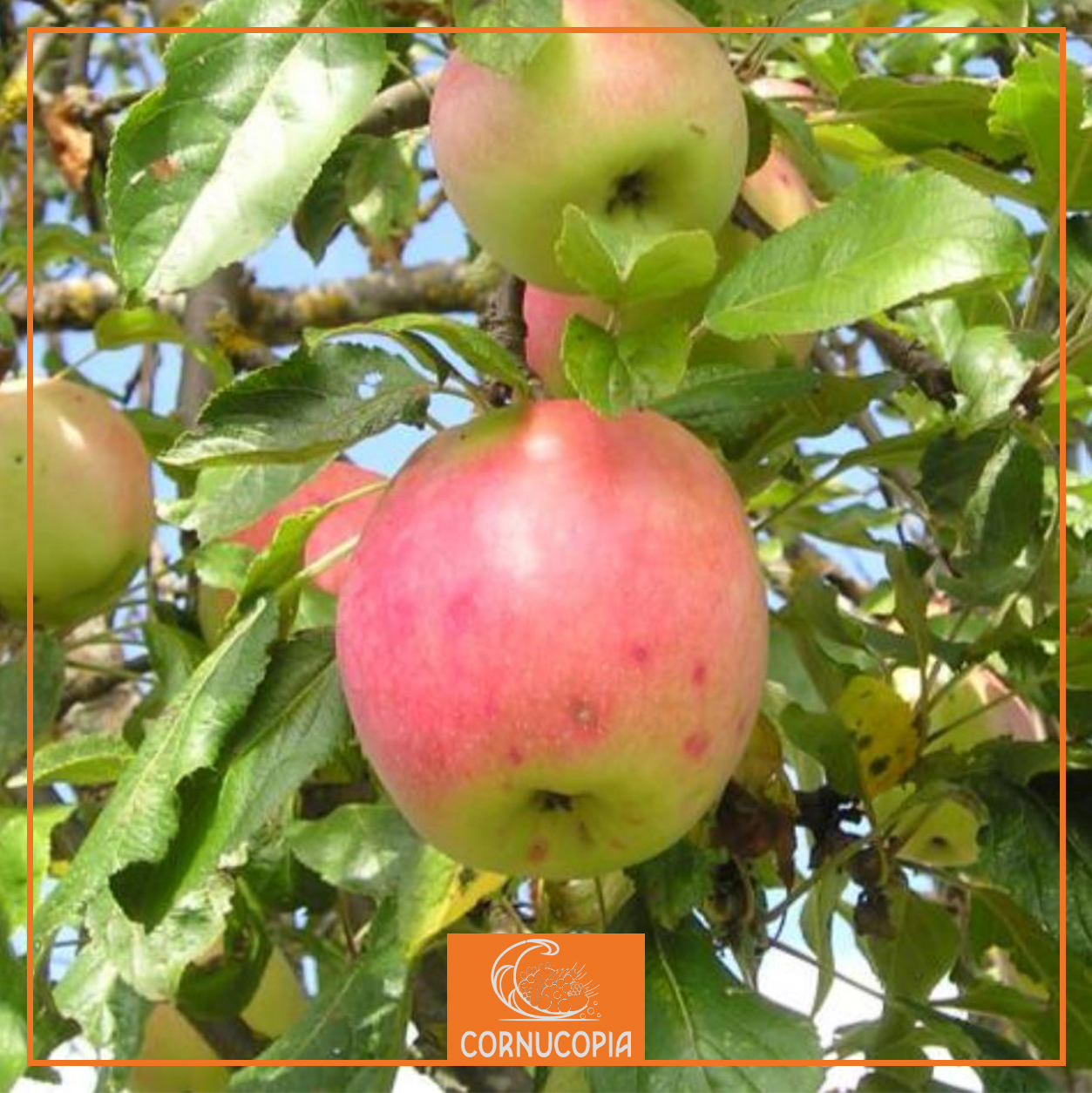
    In the cities of Emilia, Romagna and Le Marche, the shouts of the Thirty Years’ War resounded, and the Baroque spread through churches and buildings, while the Este family held court in Modena. It was the 1600s, and far from the din of shouts and cannons in the surrounding countryside and hills, with the arrival of autumn, the ground softened and mists spread silently among the rows of vines. Here, children were able to amuse themselves with what the land offered them, such as the so-called granny apple or ‘rattle apple’ (sunaìa in dialect). This apple, which elsewhere was also called ‘batocchia‘ after the sound of the bell’s clapper, took its name from a particular characteristic: the seeds inside the fruit tended to detach, creating a rattling sound when the apple was shaken. This apple was greenish-yellow in colour, with shades of bright red at sun-exposed spots, creating a wonderful colour effect. Its flesh was sweet and slightly sour, and it had that characteristic smell of apples of yesteryear. That apple is still there, fortunately, although there are no children to shake it.

    The sunaia apple shares a peculiar characteristic with one of its sister apples, typical of the Modena area: the cavicchia apple (cavécc in dialect, with the ‘c’ pronounced like the ‘c’ in chocolate and the ‘a’ closed in the Modenese way). Both apples have a particularly large internal cavity, which contains the seeds that break off and dance inside 🍎.

    As mentioned above, in addition to the hills of Emilia, the ‘mela sunaia’ was also popular in the Marche region, particularly in the area of the Sibillini and Nera river valleys and then down further to Perugia. In the Marche region, before the 1950s, mela sunaia was used to prepare paccucce, quarters of apples that were left to dry in the sun on trays or willow trellises and baked in the oven to prevent spoilage. Spartecche were often eaten as the main course of the peasant dinner during times of scarcity.

    Medicinally, apple parcels were used to treat colds in the form of herbal teas. This ancient apple was thus a valuable resource for rural populations, not only as a source of nourishment, but also for its therapeutic properties.

    In Umbria, our beloved apple takes on a wonderful role as a filling for Rocciata Folignate, a dessert made of apples, sultanas and dried fruit that is very popular throughout the region.

    Although it indicated this apple as an orange (autumn) fruit, only the harvest took place in October, but then the apple was left to ripen in the fruit cellar until December, when it released its full aroma. So delicious was the aroma that it was even used to deodorise laundry.

    The Cornucopia Recipe: Pastry of Stewed Sunaie Apples

    With this post I shall venture to inaugurate this section of Cornucopia recipes, or rather, suggestions for historical recipes attributable to the Emilia and Romagna region and to be used to enhance our agricultural biodiversity. Recipe and variety from the same region in short. This is the idea that lies at the heart of the genesis of Cornucopia, namely to create a connection between cuisine and historical varieties. Obviously this project is open to suggestions and advice, especially regarding recipes from the early 1900s countryside that still remain hidden in grandmothers’ drawers and that someone might want to share 🍩. What better legacy for these recipes than to create a direct correlation with the raw materials of our history?

    So let’s start with grandma’s apple and a recipe from our Estense steward, Cristoforo Messisbugo, whom I may tell you about one day. He is a very important figure in the history of Renaissance cuisine in my region, but there is so much to say about him that he really deserves a whole article.

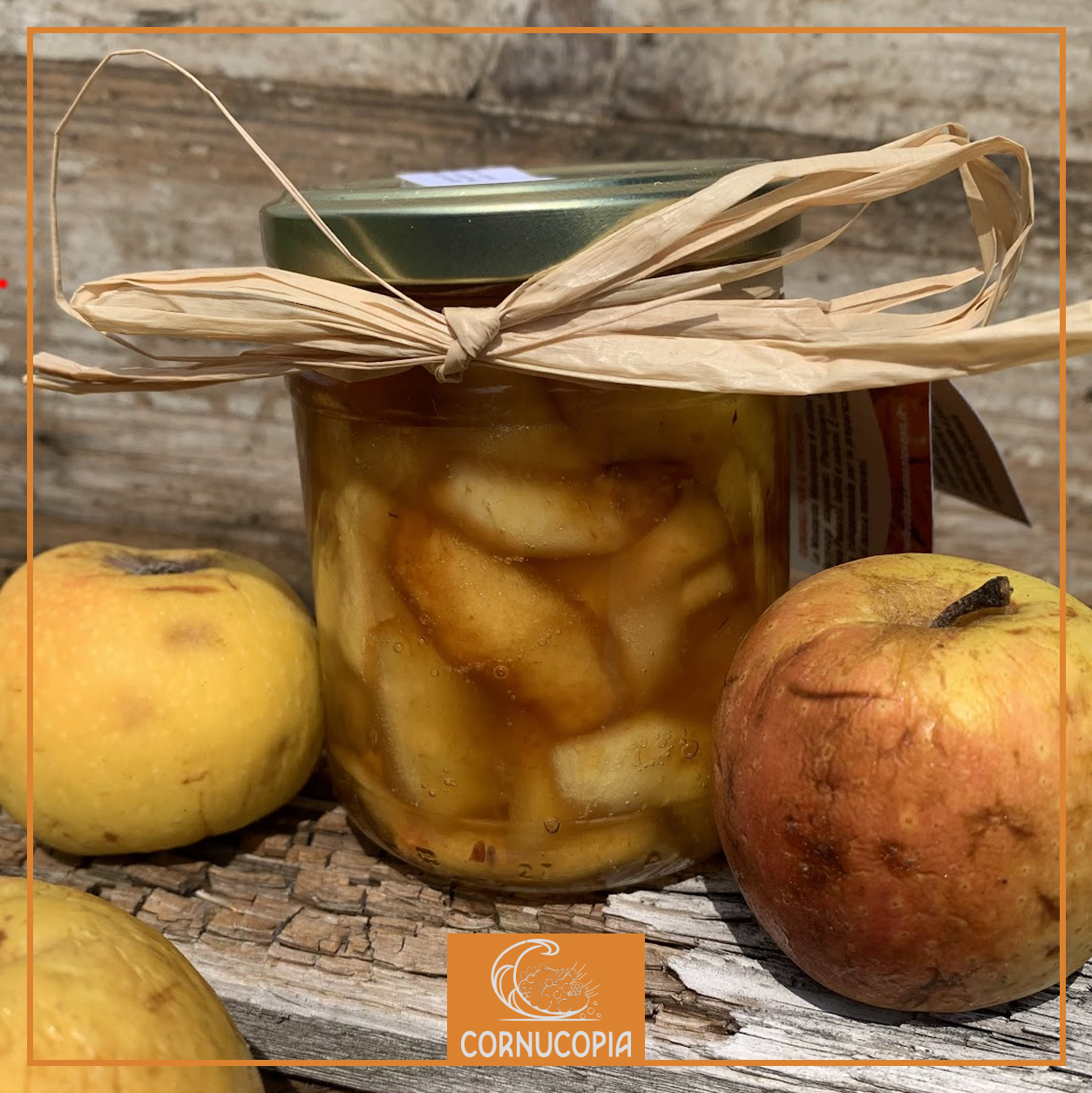
    Given the fragrance and the vocation of this apple for cooking, and since we have talked about the rocciata, which is a sheet of stuffed pastry, I thought I would propose the following recipe from the 1500s. The recipe for stewed apples (i.e. cut into pieces and cooked in wine) has two versions, one fat and one lean as they used to say in those days: as a thin pie (a ‘batter’) stuffed or as a dish containing only the filling.

    Take pears or apples in the necessary quantity to make the pastries or dishes you desire. I think you’ll need six for six pastries and eight for a dish. After giving them a good scorch in the fire, you will wash them and, once cooled, peel them while leaving the stem in the middle. Then, you will put them in a pot to boil in a good black wine with plenty of sugar, a few pieces of whole cinnamon, and a few whole cloves. You will let it cook until the flavor is well blended and it appears like a jelly. If you want to make pastries, you will prepare some crusts and fill them with the fruit mixture, or you will spread it on the dishes and sprinkle candied cinnamon on top. I think you will need six ounces of sugar, half an ounce of cinnamon, and ten cloves to make one of these pastries, while you will also use candied cinnamon to decorate the dishes or pastries.

  • Seawines of Italy, in times unsuspected

    Seawines of Italy, in times unsuspected

    Underwater cellars, wines matured in the sea, vague hints of saltiness, robust young men with long beards sporting a mixed Italo-Anglophone dictionary, shaking glasses with swollen chests like in the best marketing offices in Milan and Parma… Actually, sea wines are not exactly a novelty for our beloved fermented grape drink.

    In Cato‘s time (2nd century BC), the Romans’ appreciation of Greek wine was already evident to the point of being systematically imitated. Findings of amphorae in Modena, which had been wrested from the local Celt tribes, the Boi Gauls, as early as the 3rd century B.C. show that wine was very frequently present on the tables of the wealthy, to the point that, just as today, a strict classification by quality was made according to grape variety, processing, and origin. A bit like in our wine shops today.

    What does this have to do with sea wines? Well, it seems that oenological techniques were not exactly advanced at the time, and in these amphorae were found the remains of a wine that was laced and preserved with seawater and defrutum, a kind of cooked must related to the saba we (in Modena, Italy) use today, in Modena, as the base for balsamic vinegar.

    The greatest expert on wine in the history of Ancient Rome, the archaeologist André Tchernia (whose books have never been translated to Italian, it seems, much to the frustration of the undersigned who has to approach the French language with dictionary and apps) speaks extensively in his writings of wine preservation techniques permuted by the peoples of the eastern Mediterranean, from which the Romans later (and the Etruscans and Celts before them) purchased prized wines such as that of Kos (which is still produced with lots of resins! ) and that of Rhodes. Of these correction techniques and on how to save wines that were beginning to show an acetic hint I will tell you more later when we talk about posca, sguazzone, vin sottile and puntalone :-), but suffice it to say that herbs, honey, resins and spices were regularly added until the late 17th century to correct wine faults when ancient analogs of today’s vermuth and sangria were the order of the day on our tables.

    It also seems that in the Modena area, at the time when it was called Mutina, the most popular wines were precisely the latter, of a type that today we would call passiti, diluted therefore in small percentages with saline solutions that at the time were considered to have conservation functions, as is also the case with cheeses and cured meats. The Romans sadly tried to imitate them in a sometimes unequal competition, a bit like what happens today in the friendly competition that has been going on for decades between us and France, trying drying techniques that even reached four years under the sun (again, see Cato). Even Columella had codified procedures to imitate Greek wine, which was left to age in terracotta amphorae a bit like we do today with barrels such as the famous barrique.

    There is still a lot to be said about the production of wine in ancient times, and that it was also drunk here in Emilia-Romagna (as throughout the Roman Empire), from the crushing in the cocciopesto (Italian for ‘large vats with a bottom made of pressed shards and debris’), but that’s enough for today. I leave you with a recipe from Cato’s De Agri Coltura, the sea wine of the food snobs of the 2nd century BC.

    If you want to make Coum wine, take seawater from the high seas on a calm day with no wind, 70 days before the grape harvest, so that fresh water does not arrive (rain could alter the quality of the sea water). Once it has been taken from the ocean, pour it into a barrel, not filling it completely but leaving a five-quarter empty space. Put the lid on but make sure there is airflow. After 30 days, decant into another barrel gently, leaving the deposit at the bottom. After another 20 days, decant into another barrel, repeating the operation until the harvest. To make Coum wine, leave the grapes on the vine until they are well ripened and then pick them when dry and out of the rain, leaving them in the open air in the sun for two or three days if it does not rain. If it rains, place it under the roof on trellises and remove every rotten grain. Then take 100 litres of sea water for 50 kg of mixed grapes [‘in dolium quinquagenarium infundito aquae marinae Q. X.’]. Remove the bunches from the grapes and pour the must into the dolia, continuing until it is completely filled. Press the grapes by hand so that they absorb the sea water. Close the barrel with the perforated lid and leave it in a cool, dry place for three days. After three days, remove the contents of the cask, press them in the wine press and pour the wine into clean, dry casks.

    Cato, De Agri Coltura