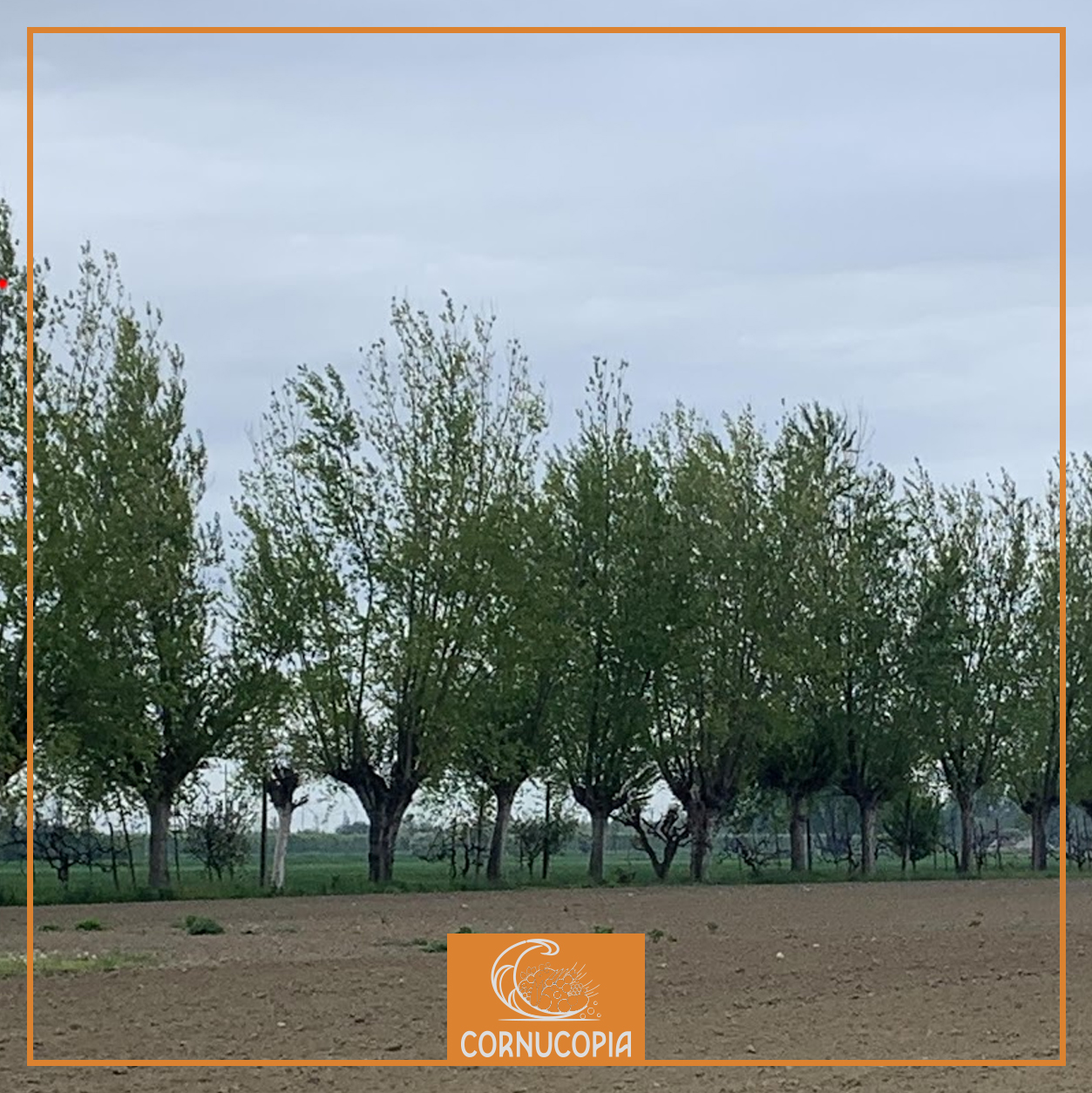
“And now what do I tell the prior, how do I climb up there?” Arnaldo looked thoughtfully at the vine shoots that grew from the base of the elm, climbing up its trunk to the cut-off top where the crown used to be, several meters higher, and then spreading out in a long vault loaded with grape clusters, stretched up to the next elm. In turn, the elm that was about ten steps to his right was wrapped in a pair of vines that also stretched out to the next one. The same pattern repeated to his left. In front of the perplexed man, a very long row of lovers, powerful, sinewy trees wrapped in the delicate limbs of the vine. The row stretched along the watercourse towards the Duke’s lands. Arnaldo’s feet were sunk in the soft ground, behind him, at a hundred steps, the shadows of another specular row. And then another one, and so on, as if a huge rake had plowed those lands, placing them like pawns on a chessboard, frozen knights and damsels in a synchronized dance, surprised by a magical winter that had turned them into plants. “Breeeee.” Arnaldo turned around, meeting a pair of horizontal pupils and yellow eyes. His musings had been interrupted by a sheep from the flock grazing in the middle of the rows. Around him, a couple of geese were rummaging in the grass around the smaller plants. Even though it was autumn, the field was teeming with life…
Invented
The above could be a description of a field from a century ago, as well as a millennium. The live stake cultivation had been a method used to grow vines for centuries. Books from the early 1900s still talk about it as a widely used method. Not a few. Out of four million hectares of vineyards, today only six hundred thousand remain. It is not entirely dedicated to monoculture, of course, the so-called “married” vine was part of a symbiotic system where wheat, legumes, and vegetables, coexisted with the vine and livestock. But let’s take a step at a time.
The Romans
Let’s go back a few centuries and make some hypotheses about the spread of these cultivation systems. In Rome, intensive vine cultivation around the capital became unsustainable, and the legionaries were tasked with exporting democ… Oh no, sorry, I meant to bring local culture to all the provinces of the Empire. Just as their bread remains with us in the form of piadine, flatbreads and crescentinas, and the olive has found its peace in the ammoniacal hills of Romagna, even wine cultivation techniques took root, mixing with the cultures of the native populations, as here in Cisalpine Gaul (Emilia-Romagna in my case), where the Romans found this curious system known in the future as the “arbustum gallicum.”
Columella, an ancient Roman writer and farmer, extols the closeness of two plants in his work. He speaks with great enthusiasm about the combination of a vine with a delicate appearance and juicy fruits, with a robust and austere tree that supports it.
“Vitibus etiam admodum antiquum genus est, quod non alit se solo, sed adiutore alio vivit, arborum frondibus: et ea vitis adhuc in Italia rarissima est, quae in arboribus nascitur; iam vero in Hispania frequens, nec ulli gentium magis placet. Nomina eius in his locis varia, namque aut platanus est aut populus aut salix aut ulmus aut pinus, etiam ilia quae apud nos vite appellatur, atque haec admodum plurima, quae varie appellantur. In his arboribus educatae vitis et in sola quidem Hispania notissima, adeo ut in hac una regione vitiis ad hoc institutis omnibus aliis locis praestet. Quaedam autem et in Italia nascuntur, sed rarae, etiam in Graecia, ubi in arundinibus educatur, et iam in Asia et Africa. Haec vitis non ita altum scandit, sed tantum quantum sufficit ad fructum ferendum. Nec tamen omnes arbores idoneae sunt, sed eas maxime quae frondibus laxioribus, ut platanus et ulmus, etiam populus, non minus salix; pinus tamen non satis. Arborum autem natura illud maximum tribuit, quod vitis saepe salubritatem afferat. Ad hanc arborum frondem vitis inhaeret, nec multum opus est ad eam sustentandam, nisi ut a radicibus singulis stirpibus adnexam arbori adhaereat. Ita unius arboris adiutorio etiam centum vites coluntur, et singulis annis ex iisdem arboribus vina feruntur, quae sunt maxime laudata.”
“There is also a very old type of vine that cannot live alone but relies on another, that is, on the leaves of the trees: this vine is still very rare in Italy, while in Spain, it is widespread and appreciated by everyone. In these places, it has various names, for it is called either plane tree, poplar, willow, elm, pine, and even the one called vine among us, and there are many other varieties with different names. The vines grown on these trees are well known only in Spain, to the point that in this region alone they exceed all others in this type of cultivation. Some of these vines also grow in Italy, but they are rare, as well as in Greece, where they are grown on reeds, and now in Asia and Africa. This vine does not climb too high, but only as much as is necessary to produce fruit. Not all trees are suitable for this cultivation, but only those with looser leaves, such as plane trees and elms, and also poplars, not to mention willows; pines, however, are not suitable. The nature of trees gives the greatest advantage, since the vine often brings them health. The vine clings to the leaves of the trees, and it does not take much effort to support it, except that it must be attached to the tree by the roots of the single plant. In this way, even a hundred vines can be cultivated with the help of a single tree, and every year the wines obtained from these same trees are highly praised.”
Columella
The Supreme Poet
Even Virgil, Dante’s guide in the afterlife, hints at the presence of this cultivation in his Georgics, a four-part poem that focuses on the practical aspects of rural life, such as agriculture, animal husbandry, beekeeping, and wine production. Written during the reign of the Roman Emperor Augustus, it was intended to promote the values of agriculture and the Roman way of life.
Colli bus an plano
Virgil
melius sit ponere vitem, quaere
prius. Si pinguis agros metabere campi,
densa sere (in denso non segnior ubere Bacchus);
sin tumulis acclive solum collisque supinos,
indulge ordinibus.
Planting a vineyard on a hill
Virgil
is best, but first seek out
the best spot. If you are tilling a rich plain,
plant densely (for Bacchus does not prefer sparse soil);
but if on hillsides and sloping ground,
plant in rows.
The mentioned lines, part of Book II, describe how to plant vines and where to do it. The passage suggests planting the vines on hilly or flat terrain, depending on the quality of the soil. If the soil is rich, the vines should be planted close together, while in less fertile soil, they should be spaced apart. The lines also suggest that the vines should be arranged in rows on the slopes of hills and on slightly sloping hills. Trees can influence the growth of the vine in various ways: they can protect it from the wind, provide shade during the hottest hours of the day, contribute to maintaining the moisture of the soil, and, above all, provide support to the vines so that they can grow healthily and regularly. In particular, the poet recommends using trees that have a sturdy and straight trunk so that they can support the weight of the vines and grapes without bending or breaking.
Virgil suggests avoiding trees that release harmful substances to the vines, such as oak, which produces an acid that can damage the plant. This last attention has not been confirmed by modern science but is a symbol of the great attention that the ancients had for agriculture.
The Middle Ages
Cultivation, like the lives of many, came to a halt with the arrival of the barbarians and the Middle Ages with the fall of the Western Roman Empire. No one would have wanted to live in the Po Valley during the terrifying period of the Gothic wars, devastated by famines and floods. The vine remained on the hill for centuries until the time of Matilda and the communal age, in the Late Middle Ages when the “arbustum gallicum” returned to the plain, this time together with cereals, in the system that would later be known for centuries as the “piantata padana.” Incidentally, this is the period in which important irrigation works were carried out, and a network of water distribution was dug, which allowed the optimization of the crops, creating a clever system of drains of various functionalities and sizes that brought together the knowledge of the monasteries that led to the famous Grana cheeses, including today’s Parmigiano Reggiano. We will come back to this (I am writing a long article, it takes time 🙂).
Today
In the nineteenth century, the “married” vine to the tree was widespread throughout Italy. In central Italy, it was the maple, then the elm in the north, sometimes the mulberry. In the South, it still survives together with the poplar, as in the discipline of Asprinio di Aversa.
Depending on the location, this cultivation method varied widely. I found documents that speak of an optimal marriage with the field maple because of a less extensive root system and a sparser canopy (the vine climbs the tree seeking warmth and sinks its roots seeking nutrients, a concept at the base of the quality of many fine wines).
In Marche and Campania (the “alberate” Aversane with its splendid “festoons“), the practice of harvesting on stairs still exists, elsewhere the practice had already been abandoned by the time of our grandparents.
Each plant had its pros and cons. The mulberry did not give excellent results, but it allowed for the collection of leaves excellent for livestock and silkworms. The walnut was perfect for lumber and dried fruit. The olive was wonderful, but it seems to have been abandoned very early due to complications with parasites. The elm has perhaps the longest and most documented history here in Emilia-Romagna, but the improvement of production techniques in the fields allowed the trees, which were previously cut down to a height of 8-10 meters, to be drastically lowered, while by the end of the 19th century, the trees had already been reduced to 3-4 meters.
Sometimes, some remnants of “planted” are still present near the homes of some old farmers who still recognize their merits today.
Emilia-Romagna
Traveling along the Via Emilia from Piacenza to Rimini in the early 1900s must have been enlightening. Each (current) province had its interpretation of the “piantata padana.” In my area, it was the elm that married the vine. I say “elm” (masculine) and not “elma” because in our parts, there is a feminine and a masculine for this plant. For “elm,” annual pruning was intended to form the rows in the countryside on which to grow the vine, crudely cut into the shape of a rudimentary sling, in jargon “capitozzati.” Even the trees changed, in Reggio Emilia, for example, the vine could also be seen married to the plum. In Bologna, they changed the number and position of the plants at the base of the support. At first, the elms were still very tall, but as I mentioned before, over time they were reduced in size. The reduced height still protected against frost, hail, flooding, and frost, even on these elms (which resisted capitozzatura or clipping very well) of medium height, certainly not 20 meters.
This system sees the vines married with their festoons as dividing the rectangular hills studied to drain the soil into drainage channels.
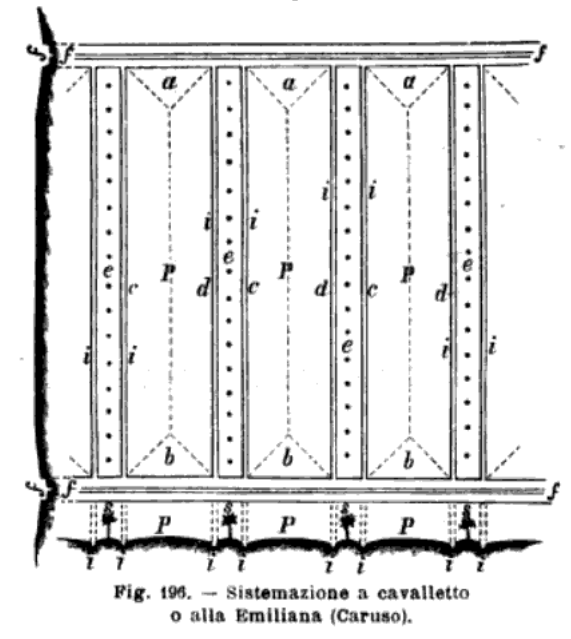
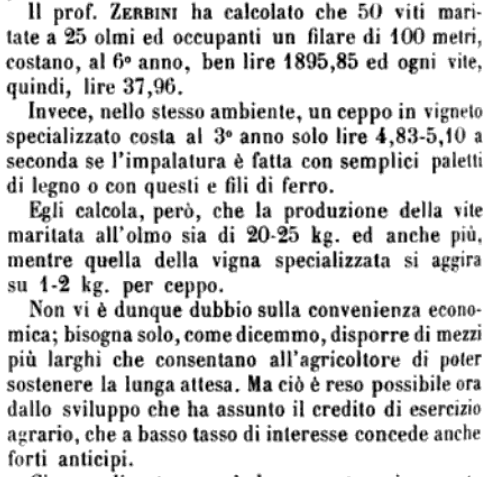
A text from the early 1900s mentions the wedded vine not only as present but as an excellent investment that can largely pay back what is spent, even if the vine takes six years to harvest and not two. Kind of reminds one of the story of the Friesian/Holstein and the Reggiana red cow, eh?
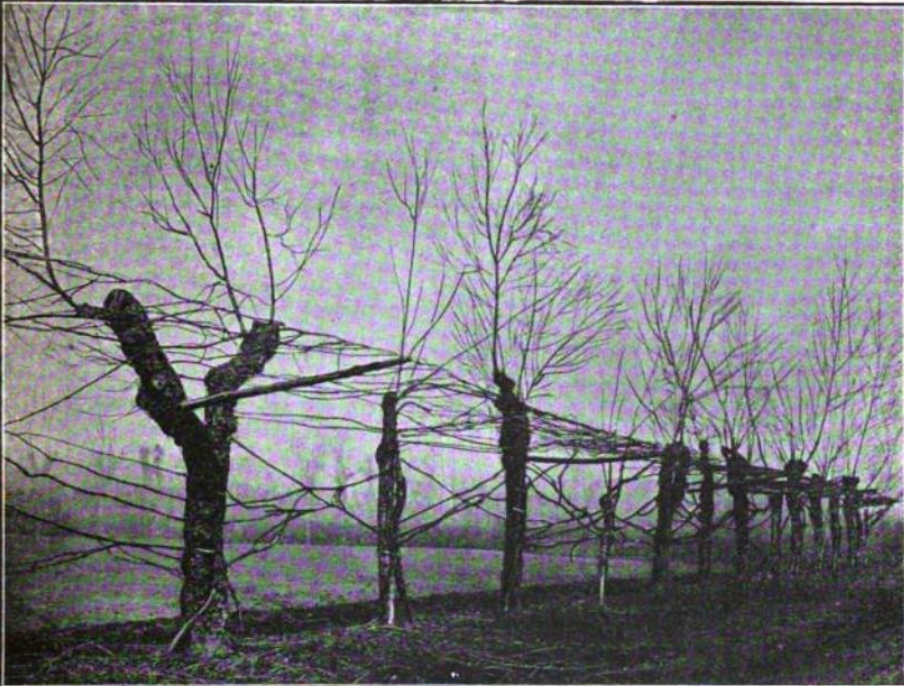
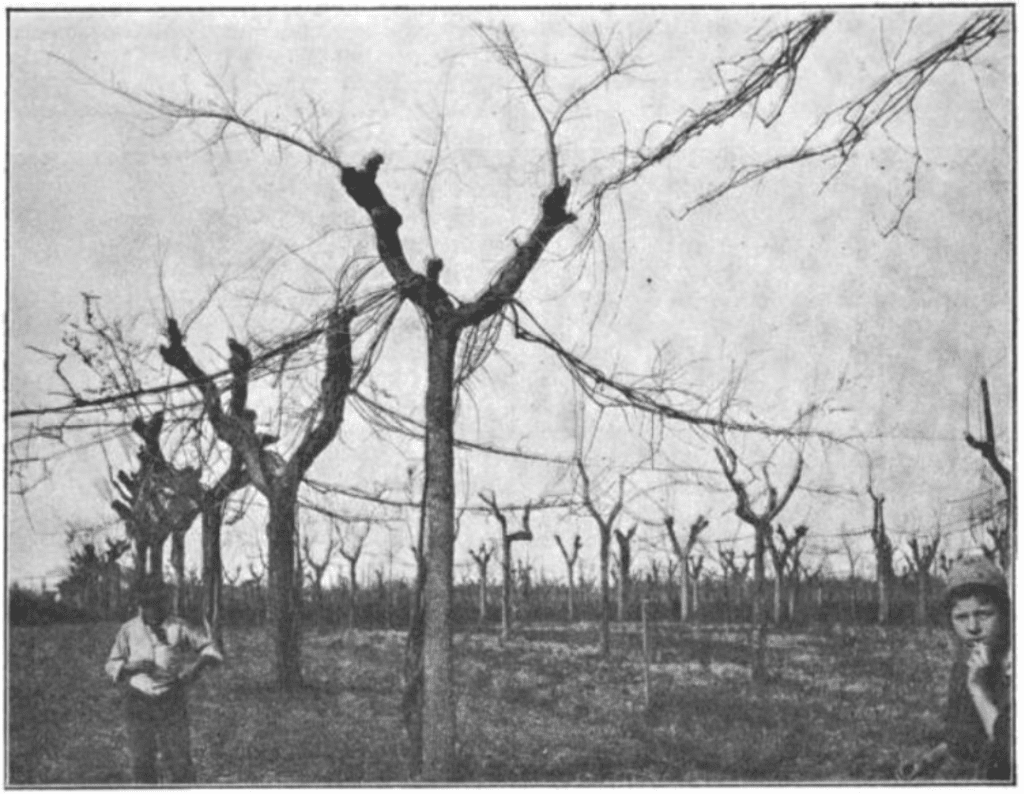
Between Modena and Reggio, the practice of pergolas on the vine rows lasted for a while, as can be seen below in an old photo of the Reggio countryside. In practice, the festoons were not only spread lengthwise, but also over the cultivated fields, on different rows, creating a large chessboard.
Between one row and the next, the fields were cultivated with turnips, oats, clover, but also horticultural crops with the rooted cuttings that were fertilised by the droppings of perches and cattle. There are texts that speak of an increase in grape production of almost 100%.
It should be noted that even dead posts, i.e. the wooden poles that replace trees (being rootless, they can be placed close together; an example of this practice is the mulberry tree, a plant with thick roots), were still 3-4 metres high until the early 1900s. Vines, in any case, were harvested high up here in the Po Valley, except in those places where they were cultivated in the field, as is done today: a practice that was once rare and called ‘low vine’.
It is interesting to see how, over the centuries, dozens of planting evolutions have developed, including this interesting model that saw a pergola going out sideways on the sunniest side of the plant.
Modena
Going into more detail, let’s look at the city of Modena, where the vineyard was cultivated using the so-called “a cavalletto” system – that strip of land where vines and trees are planted, and which at that time constituted about one-fifth of the average arable surface. Once, in the Modena area, it was a “a gronda” strip, it is said, with dimensions of 20-30-35 meters by 80-100.
Until the 19th century, two cultivation methods were widespread in Modena, the other being the Mantuan method called “a piramide”, known as the Marchi system. At that time, the vine was still married to the poplar tree, as in the South, but it quickly disappeared to make way for the more profitable elm.
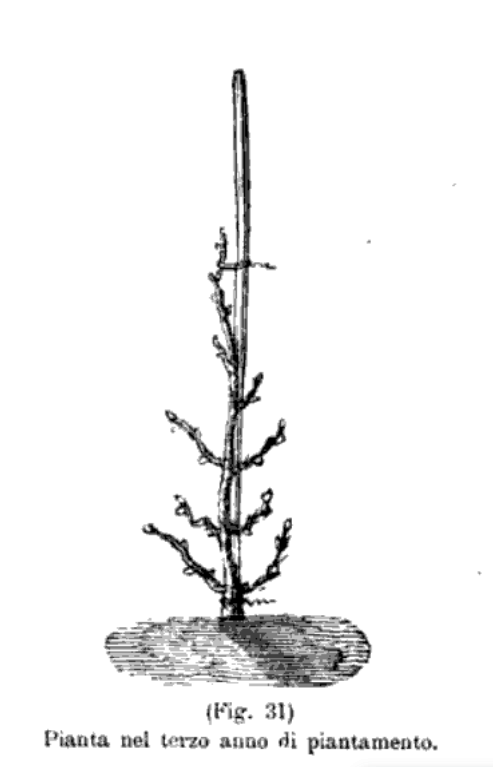
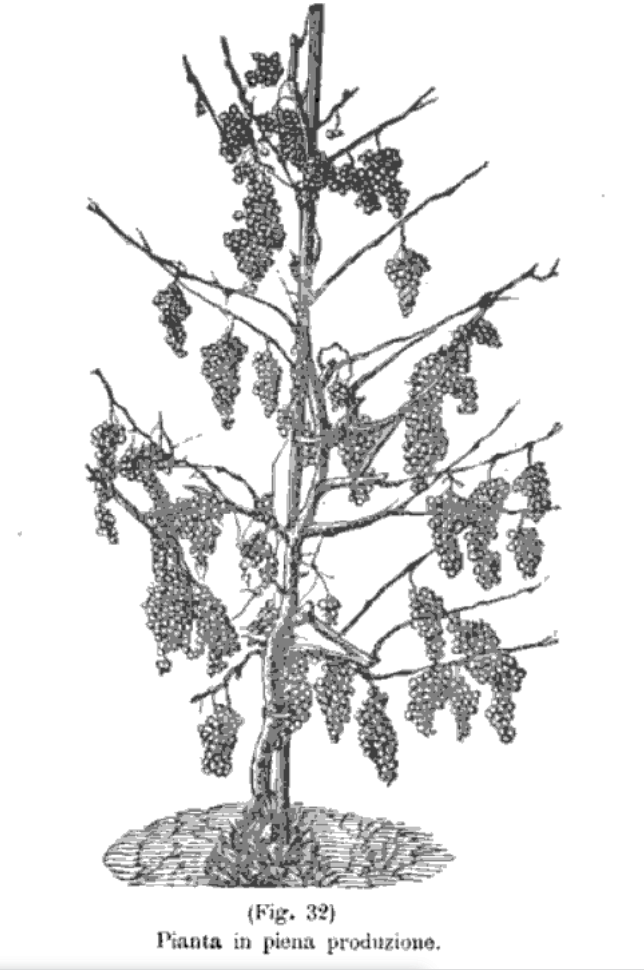
Between Modena and Reggio, the use of wire (after its introduction in vineyards in the 1820s in Lombardy) had created a spectacular effect of lattice-like festoons laden with hanging grapes over the cultivated fields, as can be seen in the photo below.
The once huge elms were pruned lower and lower until they were replaced by field maple (opium) following the decline in the importance of leaves in cattle feeding.
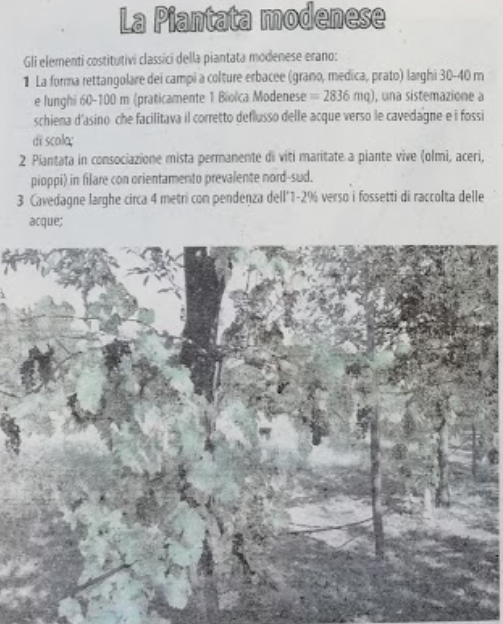
Francesco Aggazzotti, the first mayor of Formigine after the unification of Italy and the one I call without hesitation the Pellegrino Artusi of wine, gathered dozens of vine varieties in his vineyard, almost all of them marinated in elm. These include several lambrusco wines (full-bodied wines of a good 8 degrees, 8 and a half degrees :-)), including that of Sorbara and that of Tiepido, also known as the red graspa (Graspa Rossa). But let’s keep this name in mind because we will come back to it often in the future when talking about old local varieties.
Theoretically speaking, there is still a planting in Modena in Via Marconi at a nature reserve. I personally have never managed to find it open.
A short dissertation
The aim of Cornucopia is to provide reliable historical documentation by being as objective and open-minded as possible, objectively considering the reasons behind the abandonment of certain sometimes anachronistic production methods.
However, it is necessary to honestly examine all ethical, sustainable, and economic variables of the subject. The advantages of these cultivation methods are still objectively present and are suitable for high-quality production where wine is respected from its conception.
No one excludes the possibility of producing honest, qualitatively flawless, and harmless products even with advanced industrial methods. Research laboratories and control bodies prevent poison from ending up on our tables, which is still possible for small producers to bypass these screenings.
It must be said, however, that the same grip that cuts the “low” part of production is the same that cuts the high part. In other words, you lose the neighbor’s grape marc that crackles with sulfur dioxide added without any criteria in the unlabelled wine that is sold on the black market, as well as the carefully curated product, grape by grape, day by day, perhaps from an unregistered variety of vine entwined with the fig tree next to the chicken coop.
This flattening of quality towards a weighted average hammered by decrees mostly written by scientists and regulators whose natural habitat is a white formica desk covered with folders is quickly leading to the disappearance of all production that is no longer sustainable in a modern production perspective. Let’s be clear, doing business has never been an exclusively ethical process, selection was brutal even a thousand years ago, much biodiversity has been lost also thanks to a selection that led to the creation of most vegetables as we know them today, to name one. But selection took place on the objective peculiarities of the product, not on its yield on a large scale or its adaptability to production systems that clash with sustainability simply by knocking it down with increasingly sophisticated preservation techniques.
The concepts of shelf life are ancient, they are the basis for the birth of cured meats and cheeses, fruit preserves, fermentations. But how far can we go in this direction at the expense of the harmony between man and nature? Here, it is not a matter of starting to pick berries in the woods again, but of finding a balance, especially in production systems that allow small businesses to survive by giving them a chance. I would add that I am not sure that the production guidelines of most products in supermarkets will not have long-term repercussions, by milking the cow (strictly a beautiful black and white hyperthyroid Friesian, mind you, the one loved by the “consortia for the protection”) what we find on our tables are foods that are increasingly poor in nutrients.
But for that, I refer those who wish to read some scientific reviews that deal with the subject with numbers and considerations of competent personnel. The argument here could be “but the EU has already made it impossible to use various types of treatments, everything is converging towards the world of organic agriculture” etc. etc. True, absolutely. But I am not talking about soil exploitation, water resources, sustainability. Cornucopia is not an ecological project, but a project of tradition. Let’s be careful not to throw away historical cultivation methods like this.
Let’s think about the cattle farming hypothesized by André Voisin in the 1800s, now in 2023 the subject of study, or the real “piantate padane” (Padana plantations) in Germany where they are called by another name, but they are still plantations. In short, I hope that culture will not be lost, these systems, these plants, these jobs are part of our living identity and history that we can still keep alive. They are scents and flavors that we can still keep with us together with amphorae, palaces, and monuments.
If you feel like sharing photos, recipes, stories that speak of our past identity, I invite you to the Facebook group and the Telegram channel.